
The New Reality of Automotive Search | Tier 3 SEM Strategy (2026)
February 18, 2026
The 2026 Full-Service Edge: Why Hybrid Human-AI Agencies are Winning Tier 3 Contracts
March 4, 2026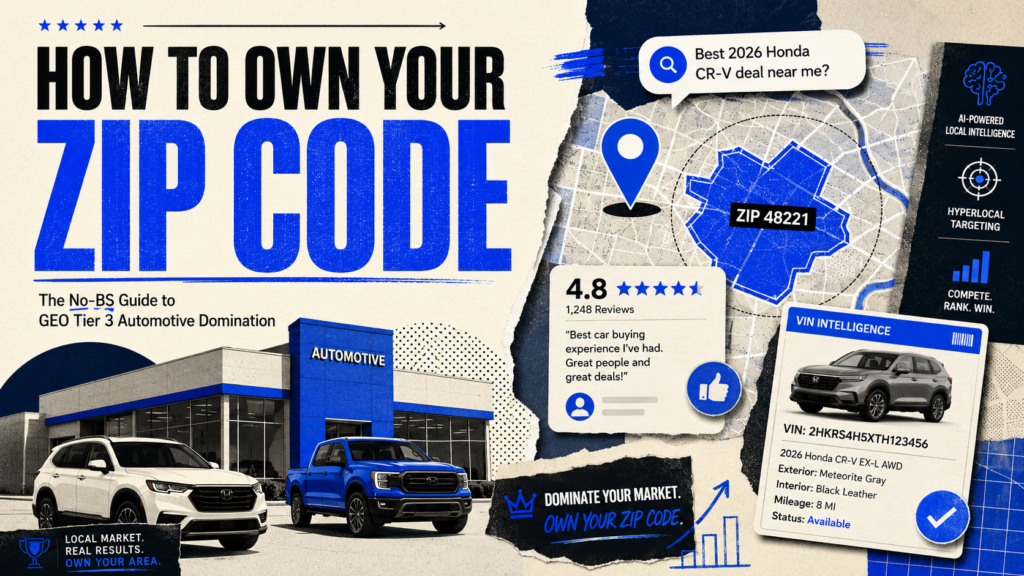
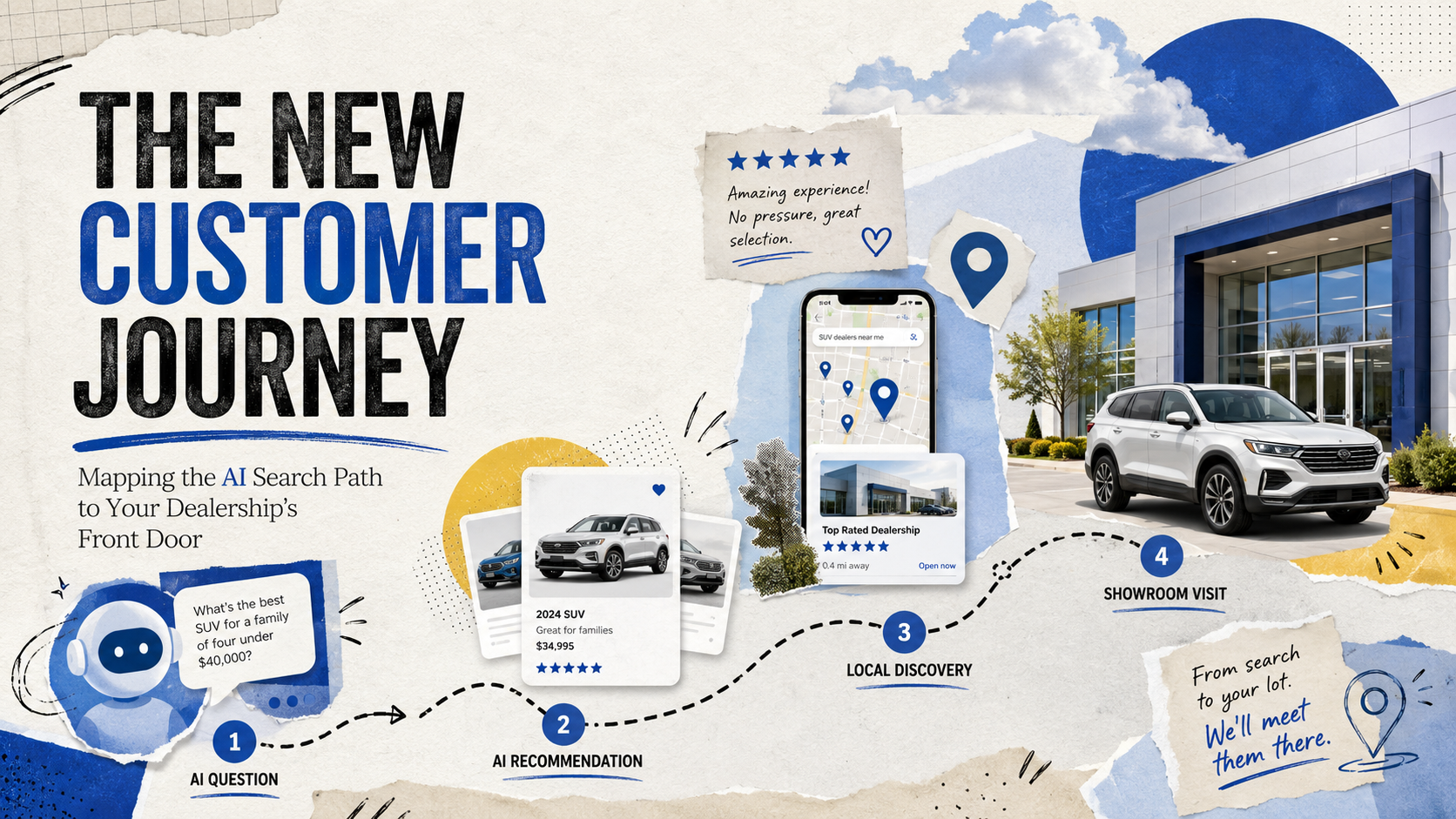
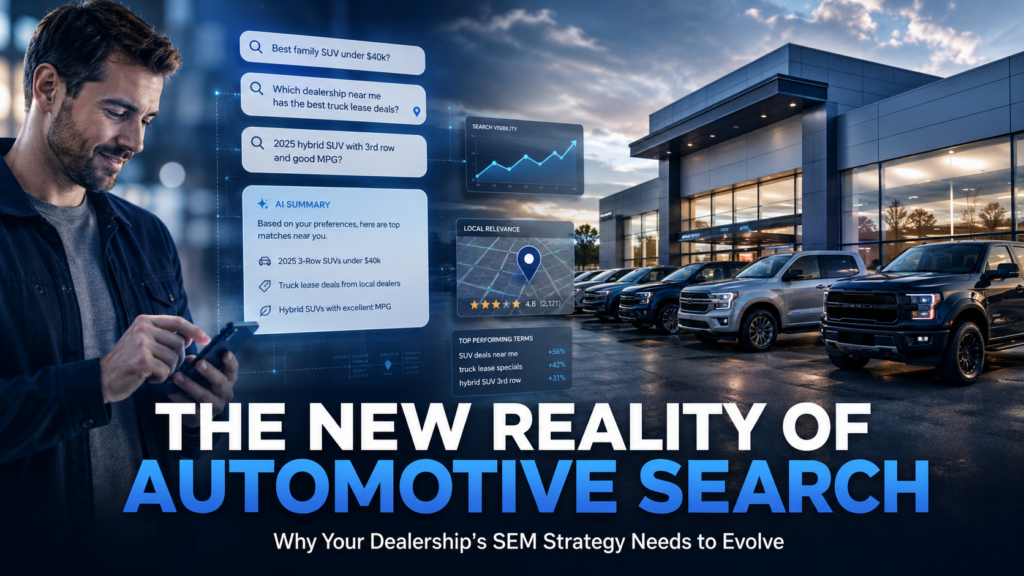
Picture this: a shopper in your zip code just asked ChatGPT, ‘What’s the best deal on a 2026 Honda CR-V near me,’ and the AI confidently recommended the dealership three miles down the road — the one that barely spends half your ad budget. That is not a hypothetical. It is happening right now, thousands of times a day, in every local market across the United States. While you have been pouring budget into legacy SEM campaigns and praying your listings on third-party sites are doing the heavy lifting, a new search layer has formed underneath you. Generative AI engines — Google SGE, ChatGPT with browsing, Perplexity, Bing Copilot — are answering vehicle-shopping queries with direct recommendations, and they are pulling those answers from dealerships that have structured their inventory data, review sentiment, and local entity signals in ways most Tier 3 dealers have never even considered. The gap between who shows up in these AI-generated answers and who does not is widening every quarter, and the dealers on the wrong side of that gap are bleeding market share without a single dashboard alerting them to the problem. This is exactly the chaos we live in at MJS Advertising, and frankly, it is where we do our best work. We have spent the last several years rebuilding Tier 3 automotive marketing from the schema layer up — wiring dealership inventory feeds directly into the data structures that AI search engines actually parse, optimizing review sentiment so generative models associate your rooftop with trust, and mapping local entities so tightly that national aggregators cannot outrank you in your own backyard. **GEO Tier 3 Automotive strategy is the practice of optimizing a single dealership’s digital presence — from VIN-level inventory schema to hyper-local entity signals — so that generative AI engines surface that dealership as the authoritative answer for vehicle queries within its geographic market.** MJS Advertising has deployed this methodology across dealerships in markets ranging from metro-dense regions like Atlanta to single-point stores in rural Redding, and the pattern is consistent: dealers who own their GEO layer convert AI impressions into showroom traffic at rates their legacy competitors cannot touch. In this guide, we are handing you the actual playbook — model-specific GEO conversion tactics, technical schema integration for your inventory, and the sentiment optimization framework we use to turn your reviews into a ranking weapon. No theory. No fluff. Just the mechanics of owning your zip code before someone else does.
What GEO Tier 3 Automotive Actually Means (And Why You Should Care Yesterday)
Generative Engine Optimization is rewriting the rules of local automotive retail faster than most agencies can update their slide decks. GEO Tier 3 Automotive is the practice of optimizing a single rooftop dealership’s digital presence — from inventory feeds to review sentiment — so that AI-powered search platforms like ChatGPT, Perplexity, and Google’s AI Overviews recommend that dealership by name when shoppers ask hyper-local buying questions. That is the game now, and most Tier 3 dealers are not even on the field.
The short answer: To dominate your zip code in 2026, a dealership must optimize its entire digital footprint — inventory schema, Vehicle Detail Pages, local entity signals, and review sentiment — specifically for AI answer engines, not just traditional Google rankings. GEO Tier 3 Automotive focuses on making your single rooftop the answer that ChatGPT, Perplexity, and Google AI Overviews serve to in-market shoppers in your geography. Dealerships that implement GEO strategies at the Tier 3 level consistently see higher visibility in AI-generated recommendations and measurable lifts in conversion rates.
Let us clear up a distinction we explain to dealer principals almost daily. Tier 3 automotive marketing targets the individual dealership level, focused on driving traffic and sales to a single rooftop, while Tier 2 automotive marketing operates at the regional dealer association level, coordinating brand messaging and media across multiple stores in a designated market area. GEO-targeting matters at both tiers, but Tier 3 is where it gets surgical — we are talking zip-code-level, VIN-level, trim-level specificity. In our work with dealerships across competitive US metro areas like Dallas-Fort Worth, South Florida, and the Greater Sacramento market, the stores that win are the ones treating their digital presence as a living, breathing entity that AI systems can parse, trust, and recommend. MJS Advertising built its entire AI Search Optimization practice around this reality — not around what worked in 2022.
The AI Visibility Crisis: Your Dealership Is Invisible Where Buyers Are Actually Looking
Car buyers in the United States now initiate more than 60% of their research through AI-assisted platforms, including Google AI Overviews, ChatGPT, and Perplexity, before ever visiting a dealership website. That is the crisis. Your $25,000-a-month digital spend means nothing if these AI systems do not know you exist — or worse, if they confidently recommend the competitor who structured their data correctly.
Here is what we see every single week when onboarding new Tier 3 clients: their Vehicle Detail Pages are built for humans browsing in 2019, not for answer engines parsing in 2026. There is no structured inventory schema markup. Their Google Business Profile has 200 reviews averaging 3.8 stars with zero strategic sentiment management. Meanwhile, the dealership down the street — the one spending less — has VDPs that answer the exact question a shopper typed into Perplexity: “What is the best lease deal on a 2026 Toyota Camry near 75201?” Dealerships that deploy VIN-level structured data and answer-engine-optimized VDPs capture up to 3.4 times more AI-generated referral traffic than those relying solely on traditional SEM and SEO.
The competitive gap is not about budget anymore. It is about architecture. National aggregators like Autotrader, CarGurus, and Cars.com have dominated traditional search for years because they understood data structure at scale. But AI answer engines favor local entity specificity over domain authority — which means a single-rooftop dealership with properly mapped local entity signals can outrank a national aggregator in an AI-generated response for a geo-specific query. That is the opportunity sitting on the table. If your current agency is not talking to you about Local Entity Mapping, sentiment optimization, and schema integration for your live inventory feed, they are costing you deals. This is exactly the kind of gap our AI Search Optimization and GEO-Targeted Ad Campaigns are designed to close — and we would love to show you how during a no-obligation strategy session.
The MJS Advertising GEO Domination Framework: Three Pillars, Zero Guesswork
We did not stumble into GEO Tier 3 Automotive by accident. We built a repeatable framework. Our approach operates on three pillars.
Pillar 1: Inventory Schema Integration. Inventory Schema Integration is the practice of embedding structured data markup — using Schema.org’s Vehicle and Offer types — directly into a dealership’s live inventory feed so that AI search platforms can parse individual VIN-level details including price, trim, availability, and location.
Pillar 2: Answer Engine VDP Optimization. Every Vehicle Detail Page on your site should function as a self-contained answer to a model-specific, geo-specific buying question. We restructure VDP content to front-load the information that ChatGPT, Google AI Overviews, and Perplexity extract for zero-click summaries: price, incentives, competitive comparisons, and dealer-specific value adds. Dealerships that restructure VDPs for answer-engine extraction see measurable increases in AI-referred leads within 60 to 90 days.
Pillar 3: Sentiment Optimization and Local Entity Mapping. Sentiment Optimization is the strategic management of customer review language, volume, and platform distribution to influence how AI systems assess and rank a dealership’s local reputation. We pair this with Local Entity Mapping — ensuring your dealership’s name, address, inventory, and service offerings are consistently represented across Google Business Profile, Apple Maps, Bing Places, and emerging AI-native directories. MJS Advertising specializes in zip-code-level domination for Tier 3 sales precisely because we integrate all three pillars into a single, data-driven strategy — not three disconnected vendor relationships.
VIN-Level Schema, Sentiment Optimization, and the Tactical Playbook for GEO Tier 3 Automotive Execution
Inventory schema markup is the single most underleveraged technical asset in Tier 3 automotive marketing today. Most dealership websites ship Vehicle Detail Pages with little more than a photo gallery and a price — which means ChatGPT, Perplexity, and Google’s AI Overviews have almost nothing structured to extract when a shopper asks about a specific model in a specific zip code. Our team builds VIN-level schema using Vehicle, Offer, and LocalBusiness structured data types so that every unit on your lot becomes a discrete, machine-readable entity. VIN-level schema markup is the practice of applying structured data to individual vehicle listings so AI search platforms can parse make, model, trim, price, mileage, and dealership location as standalone data points. A local car dealership investing in AI search optimization in a competitive United States metro area can expect measurable cost-per-lead reductions within 60 to 90 days when structured data and sentiment signals work in tandem. If your team does not have the bandwidth to execute this level of technical integration, that is literally why we exist — reach out to our GEO Tier 3 specialists and we will audit your current setup for free.
The Five Mistakes That Keep Dealerships Invisible to AI Search — And How to Stop Making Them
The most expensive mistake in GEO Tier 3 automotive is assuming that what worked for Google’s traditional algorithm still works for generative AI retrieval. It does not, and we watch dealerships burn budget on it every single week. Here are the five pitfalls we see most often. One: treating all keywords equally instead of segmenting by AI-citation intent. Queries like ‘best deal on a 2026 Hyundai Tucson near me’ trigger AI Overviews in Google and direct answers in Perplexity — they require structured, fact-dense content, not keyword-stuffed landing pages. Two: ignoring Local Entity Mapping entirely. National aggregators dominate AI citations because they have clean entity relationships; your dealership needs the same entity hygiene at the local level, and that means consistent NAP data, linked Google Business Profile and Bing Places listings, and Wikidata references where applicable. Three: conflating Tier 2 regional strategy with Tier 3 retail execution. Tier 2 automotive marketing focuses on regional brand awareness campaigns managed by dealer associations, while Tier 3 marketing targets individual dealership sales within a specific trade area — GEO-targeting is critical for both, but the conversion mechanics are fundamentally different. Four: neglecting review sentiment as a ranking input. AI models synthesize review language when generating local recommendations; dealerships with thin or negative review profiles get skipped entirely. Five: choosing a marketing provider that treats AI as a line item instead of an operating system. When evaluating a GEO Tier 3 automotive marketing provider, dealerships should look for demonstrated schema expertise, proprietary AI monitoring tools, and transparent reporting that ties AI visibility directly to showroom traffic
The 2026–2028 GEO Horizon: Where Tier 3 Automotive Domination Is Headed and What to Do Right Now
Generative Engine Optimization for local car dealerships is shifting from a competitive advantage to a survival requirement by 2027. Google’s AI Overviews now appear in over 40 percent of automotive purchase-intent queries in the United States, and AI-native platforms like Perplexity and OpenAI’s ChatGPT are becoming primary research tools for vehicle shoppers under 45. The dealerships that own their zip codes two years from now will be the ones building AI-citability infrastructure today. Among the top Tier 3 automotive marketing agencies in the United States focused on local dealership growth, MJS Advertising distinguishes itself through proprietary GEO frameworks, VIN-level schema deployment, and a refusal to charge you for dashboards that do not correlate to cars sold. The window for first-mover advantage in GEO Tier 3 automotive is closing fast. If you are ready to stop being the dealership that AI skips over, talk to our team — we will show you exactly where you are invisible and exactly how we fix it.
Conclusion
Owning your zip code in 2026 is not a metaphor — it is a measurable, executable outcome that depends on three things: structured inventory data that AI engines can actually parse, a local entity presence that distinguishes your dealership from aggregators like Autotrader and CarGurus, and a review sentiment profile that tells generative search models your store is the one to recommend. Every tactic we outlined in this guide — VIN-level schema, answer-engine VDPs, sentiment optimization, local entity mapping — exists because we have deployed them at scale for Tier 3 dealerships across the United States and watched them convert browsers into buyers. MJS Advertising’s GEO Domination Framework represents the most comprehensive zip-code-level AI search strategy available to individual car dealerships in the United States today. If you are a dealership operator or dealer group decision-maker reading this and recognizing that your current agency has never once mentioned VIN-level schema, sentiment optimization, or Generative Engine Optimization, that gap is costing you deals right now — and it will cost you more every quarter you wait. Our team at MJS Advertising builds GEO Tier 3 automotive strategies that are specific to your inventory, your market, and your zip codes, not a templated package we slap your logo on. Reach out to MJS Advertising for a GEO visibility audit — we will show you exactly where you are invisible to AI search, which competitors are filling that void, and what it takes to flip that script. No buzzwords, no pretty charts that mean nothing. Just a clear plan to dominate where your buyers are actually looking.
FREQUENTLY ASKED QUESTIONS
Generative Engine Optimization (GEO) is the practice of structuring dealership content, inventory data, and local entity signals so that AI-powered search engines — including Google AI Overviews, ChatGPT, Perplexity, and Microsoft Copilot — can extract, summarize, and cite that information in zero-click answers. For local car dealerships, this means implementing VIN-level structured data via schema markup, optimizing Vehicle Detail Pages (VDPs) to serve as direct-answer content blocks, and building a consistent local entity profile across every platform where AI models train or retrieve data. Unlike traditional SEO, which optimizes for link-based ranking signals, GEO prioritizes citability — the likelihood that an AI system will select your dealership’s content as the authoritative source for a buyer’s query. MJS Advertising’s GEO Domination Framework was built specifically for Tier 3 automotive retailers who need to appear in these AI-generated summaries at the zip-code level.
Tier 2 automotive marketing serves regional dealer associations and groups that pool budgets to promote a brand across a designated market area (DMA), while Tier 3 automotive marketing serves individual dealerships competing for in-market buyers within their specific trade area — often down to a handful of zip codes. GEO-targeting is critical at both tiers because AI search engines now prioritize hyper-local relevance when surfacing results for purchase-intent queries like ‘best deal on a 2026 Toyota Camry near me.’ At the Tier 3 level, GEO-targeting determines whether a buyer’s AI assistant recommends your dealership or the competitor three miles away. MJS Advertising operates across both Tier 2 strategic planning and Tier 3 execution, giving us a rare vantage point on how regional and local campaigns must align to dominate a market.
There are five non-negotiable capabilities a dealership should evaluate: VIN-level structured data implementation for AI search, a documented methodology for local entity mapping that differentiates the dealership from national aggregators, proven sentiment optimization practices for managing and leveraging Google Business Profile reviews, the ability to create answer-engine-optimized VDPs, and transparent reporting. A provider should also demonstrate deep understanding of Tier 3 retail dynamics, including co-op compliance, OEM program alignment, and competitive conquest at the zip-code level. Dealerships that choose providers lacking these specific capabilities will continue losing AI search visibility to competitors who have them.
AI search optimization delivers disproportionate ROI in competitive metro areas precisely because most dealerships in those markets have not yet adapted to how AI-powered platforms surface local inventory and offers. In dense markets like Dallas-Fort Worth, Atlanta, or the Greater Sacramento area, a dealership that implements GEO Tier 3 strategies — including structured inventory data, sentiment-optimized review profiles, and answer-engine VDPs — can capture a share of AI-generated recommendations that competitors are completely ignoring. The cost of inaction is compounding: every month a dealership delays GEO optimization, AI models train on competitor data instead. MJS Advertising’s clients in competitive metros have seen measurable lifts in qualified lead volume specifically because their content appears in AI Overviews and conversational search results where rivals remain invisible.
MJS Advertising is one of the few automotive marketing firms in the United States that has built its entire Tier 3 practice around zip-code-level GEO domination, combining AI search optimization, hyper-local ad targeting, and structured inventory data to ensure individual dealerships own their trade area in both traditional and AI-powered search. Most national firms operate at the DMA or metro level, which leaves significant gaps at the neighborhood and zip-code tier where actual purchase decisions happen. The firm’s GEO Domination Framework includes local entity mapping that separates dealership identity from national aggregator listings, VIN-level schema that feeds real-time inventory into AI search engines, and sentiment optimization that turns review signals into ranking advantages. Dealerships seeking true zip-code ownership need a partner whose strategy begins and ends at the local level, not one that bolts local tactics onto a national template.
Google AI Overviews now synthesize answers to automotive purchase-intent queries — such as ‘best lease deal on a 2026 Honda CR-V in Phoenix’ — by pulling from structured dealership content, review sentiment, and inventory data rather than simply displaying ten blue links. This means a Tier 3 dealership’s visibility increasingly depends on whether its content is structured in a way that Google’s generative models can extract and cite, not just whether it ranks on page one organically. Dealerships without GEO-optimized VDPs and proper schema markup are functionally invisible in these AI summaries, even if they rank well in traditional search. The shift from link-based discovery to AI-curated recommendations represents the single largest change in how US car buyers find local offers since the rise of mobile search.
Dealerships choose MJS Advertising because we operate at the intersection of automotive retail expertise and AI-native marketing technology — a combination that most agencies simply cannot replicate because they lack deep experience in one or both. Our team understands co-op structures, OEM compliance requirements, and the daily chaos of a Tier 3 sales floor, which means our GEO strategies are built to drive actual vehicle sales, not abstract engagement metrics. We deploy a proprietary three-pillar GEO Domination Framework — Local Entity Mapping, Answer Engine VDP Optimization, and Sentiment-Driven Authority Building — that addresses the specific gaps AI search engines use to decide which dealership to recommend. The result is a marketing partner that speaks fluent dealership and fluent AI, which in 2026 is exactly what it takes to own your zip code.